
Bayle Museum
HeritageThe Bayle Museum: Nine Centuries of Memory in Bridlington's Ancient Gatehouse
Stand beneath the stone archway of the Bayle Gate on a quiet morning and you can almost hear the centuries layered in its walls. The worn flagstones underfoot have been crossed by Augustinian canons murmuring matins, by Napoleonic soldiers billeted on their march north, by Victorian fishermen's wives grieving after the deadliest storm in living memory. This is not a museum that was purpose-built. It is a building that accumulated so much history within its rooms that, eventually, someone had the good sense to start displaying it.


The Bayle Museum occupies one of the oldest secular structures on the Yorkshire coast. Its name comes from the Old French baille, meaning enclosure or ward, and the building's origins reach back to the turbulent mid-twelfth century. Archaeological surveys have dated the original stonework to around 1143, when William le Gros, Earl of Albemarle, seized Bridlington Priory during the civil war between King Stephen and the Empress Matilda. He expelled the Augustinian canons, threw up a wooden palisade castle on the priory grounds, and built this gatehouse in stone to guard its entrance. When the fighting subsided, le Gros made his peace with the Church, granting the priory six parcels of land in restitution. The canons returned. The gatehouse remained.
By the fourteenth century the Bayle Gate had been absorbed into the priory complex proper, serving as its formal entrance. A porter occupied the ground floor, collecting tolls from those who passed through the arch, while an almoner beside him distributed bread and ale to the poor. Richard II granted a licence to crenellate in 1388, authorising the priory to fortify itself, but only the gatehouse was ever truly strengthened. The priory itself was never walled.
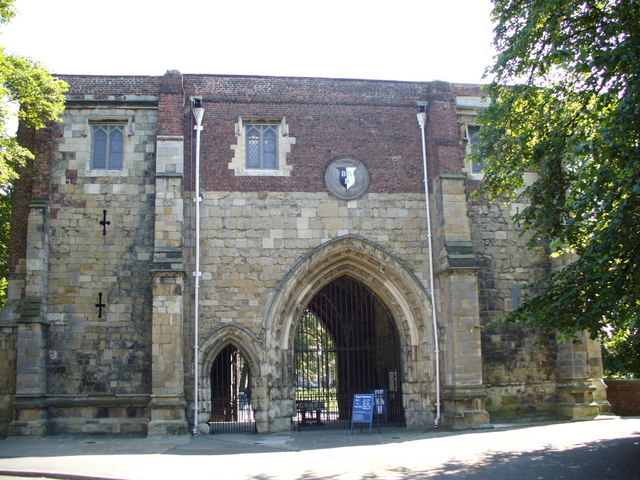
After the Dissolution, with the priory canons scattered and the great church falling to ruin, the Bayle Gate began its long second life as the civic heart of Bridlington. It served, at various points, as a prison, a courthouse, a schoolroom where merchant apprentices learned their trade, a garrison for Napoleonic soldiers en route to Scarborough Castle, and finally a town hall. In 1633, Sir George Ramsey sold the Manor of Bridlington for £3,260 to William Corbett and twelve other townsmen. Three years later, on 6 May 1636, a deed was drawn up declaring these citizens the Lords Feoffees and Assistants of the Manor of Bridlington, empowering them to enrol twelve further Assistants. It was a radical act of local self-governance — a community buying itself — and the Feoffees have met in the Bayle's upper courtroom ever since, making it one of the longest continuously used civic meeting rooms in England.
What the walls hold
Climb the spiral staircase today and the museum unfolds room by room, each chamber shaped by the building's own quirks of medieval architecture. The maritime displays are perhaps the most affecting. Antique fishing nets, lobster pots, sou'westers and oilskins conjure the cold, salt-stung reality of Bridlington's centuries-old fishing trade. But it is the two figureheads from the Great Gale of 1871 — mounted by the window, gazing out as if still scanning the horizon — that stop visitors in their tracks. On 10 February of that year, a ferocious North Sea storm drove twenty-eight vessels ashore at Bridlington. Seventeen came in simultaneously, smashed to pieces along the beach. Fifty people perished, among them six crew of the lifeboat Harbinger. The tragedy drew a line in British shipping history and is still commemorated annually at Bridlington Priory Church on Fishermen's Sunday.


Elsewhere in the museum, a pair of delicate gloves recalls the night in February 1643 when Queen Henrietta Maria, wife of Charles I, landed at Bridlington Quay with munitions for the Royalist cause and came under bombardment from Parliamentary ships in the harbour. The Military Room preserves medals and honours from both World Wars, together with accounts of local residents' service and home-front sacrifice. The Kidcote — the building's old gaol cell — has been fitted out with police equipment and law-enforcement artefacts, a visceral reminder that this same stone room once held real prisoners. A reconstructed Victorian Kitchen sits nearby, alongside displays of medieval documents, clay pipe-making tools, hand-carved "Mouseman" furniture by Robert Thompson's workshop, and a ship's mascot whose story alone is worth the visit.
A living institution
What makes the Bayle Museum unusual is not merely the age of its building — though a Grade I listed structure and Scheduled Ancient Monument deserves every superlative — but the continuity of the institution behind it. The Lords Feoffees have stewarded Bridlington's civic life without interruption since 1636, and they continue to subsidise and manage the museum as a free, non-profit resource for the community. The upper courtroom where they meet is itself an exhibit: lined with oak cabinets holding centuries of records, it is a working archive that doubles as a functioning council chamber.


The 2001 renovation brought interactive exhibits and lifelike models into the displays without sacrificing the atmosphere of the medieval rooms themselves. Annual themed exhibitions in the upper courtroom keep the programme fresh — the 2026 season, which opened on 30 March, features Curious Collections, an exhibition inspired by the old-fashioned cabinet of curiosities, bringing together objects that span history, mystery and discovery. Admission remains free, and educational groups are welcomed without charge, with transport assistance available for school visits.
The Bayle Museum is open Monday to Saturday, 11:00 am to 4:00 pm, and can be found at Baylegate, Old Town, Bridlington, East Yorkshire YO16 7JT.
This article was partly inspired by a collection of old photographs and a handful of fragile audio recordings that came to light when someone brought their personal family memories to be digitised. Among them were images of Bridlington's Old Town that sent us down the path of the Bayle's remarkable story. It made us wonder what else might be out there — in attics, shoeboxes, old cupboards — connected to this museum and the community it has served for nearly nine centuries. If anyone holds old photographs, cine film, videotapes or audio recordings connected to the Bayle Museum or Bridlington's heritage, services like EachMoment can help preserve them for future generations.